
Hi_Link_LD2410C_demo
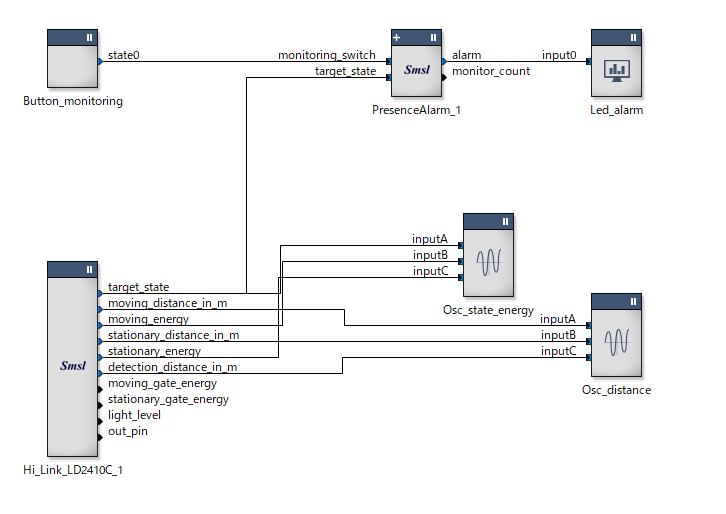
Hi_Link_LD2410C_demo.rtd is an example of a left-behind alarm with the Hi-Link LD2410C 24 GHz mmWave human presence radar.
The sensor itself decides whether a person is present; the PresenceAlarm macro uses that result (the target state decoded by the Hi_Link_LD2410C component) to raise an alarm. Turn on the monitoring switch (the Monitoring button) when nobody should be left (for example after the doors are locked). If a person is still detected for about 20 seconds after that, the alarm (the Alarm LED) turns on and stays on until the switch is turned off. A person who leaves the detection range after the switch is turned on does not raise the alarm. The distances, the target state and the energies are shown in Oscilloscopes.
In a real system, connect a switch signal that means "nobody should be here from now on" to the monitoring switch input instead of the button: the door lock, a door-closed switch, the ignition being turned off, or the end of a task.
The LD2410C is a human presence sensor: it reports whether a person is present (moving / stationary) and the approximate distance (0.75 m per gate, up to about 6 m). It does not measure the distance to walls or objects. On a mobile platform, use it while the platform is stopped:
- Checking the surroundings before starting (AGV, AMR, work vehicles): while stopped, check that nobody is crouching or standing still nearby before moving off. The radar sees through plastic covers, so it can be mounted inside the body.
- Detecting an approaching person (reception and delivery robots): while waiting, start guidance or open a door when a person comes near.
- In-cabin monitoring: after the occupants leave, check that nobody remains in the cabin by detecting the slight motion of breathing (stationary detection). The cabin is about 2 m deep, so setting the maximum gate to 2 or 3 makes it less sensitive to people passing outside. The demo is an example of this use.
While the sensor moves, walls and the floor also look like moving targets and false detections increase, so it cannot be used while driving. It is not a safety device (not certified for functional safety); to protect people, use it only as an aid to a certified sensor.